Showing posts with label tech. Show all posts

Thursday, July 9, 2015

read read ready read

I finally bought a Kindle.

I hadn't really wanted one, or known I wanted one. We have a Paperwhite in the house, but the text has been just a bit too jaggy for me, and I already have an iPad and iPhone...

Amazon released the Kindle Voyage, which has some new experimental features (apparently you can press the edges to turn the page, and it vibrates?), but also has a 300dpi e-ink screen, which eliminates the jaggy-font problem. While I was hesitating because the Voyage is expensive and weird, Amazon upgraded the Paperwhite to the 300dpi screen, and I was so excited I had it sent to my in-laws' in Washington so it would arrive while we were there and I wouldn't have to wait.

The Kindle is totally awesome and I'm chewing through all my library books on it. After a couple days, though, I noticed it was doing this thing called spotlighting, where you can see the effects of the individual LED backlights. I would never have heard of it, except there was a generation of Mac laptops that had it quite severely:


It doesn't prevent me reading stuff, but I'm returning it anyway.

When I told Amazon's return process on the website that I wanted a replacement instead of a refund, they directed me (without comment) to Customer Service. Customer Service, it turns out, were themselves a bit confused about why I was talking to them, but they sent me to a "specialist," who via typing-chat walked me through her script of rebooting the Kindle and then facilitating the return.
"A specialty team will be in touch within 24 hours to schedule a pick-up of the device."
This is not normal. I've done a lot of Amazon returns: they give you a shipping label, you package the thing up and drop it off at the UPS Store, you're done.

It turns out all the extra hoops are because Amazon Engineering wants the broken device themselves.

Thursday, October 20, 2011

polyglot

Since I've been teaching J how to program in Scratch off and on, I had the rare moment of talking to my parents about programming languages the other day. There's not usually much to say about specific programming languages with someone who doesn't write code--though there's lots to say about the nature of programming, and I have a blog post in the works about that--but I mentioned I was reading some horrible C++ code and it was a little tricky because I don't really know C++. I used it a couple semester in college and that was it. Mom said, "But you can tell it's horrible anyway?", which I can, and that got me thinking about why, and what I understand about programming languages and how they're related, and all kinds of stuff.

Programming languages are not mathematically related to human languages, but they're related inasfar as they're made by and for humans. Much like human linguists, we talk about "families" and "dialects", and languages influence each other's development, often with cycles of back-and-forth borrowing of ideas. To see this profusion, take a look at the canonical Programming Languages Family Tree, or O'Reilly Media's much prettier version (now somewhat out of date).

Making a programming language is now well-enough understood that college students do it in one semester. Making a programming language that's useful is a whole other project, and highly likely to fail. Solving a real-life problem isn't just about the language, but about its associated libraries, which need to:
  • manipulate files on disk and otherwise talk to the computing environment.
  • deal with networking.
  • deal with multiprocessing (doing more than one thing at a time).
  • provide utilities for common programmer needs, like finding the length of a string of text.
This is a lot of work, and programmers have limited time to learn new things and even less time to actually adopt them, so your language has to have something special to offer to get off the ground. Java, for instance, looks a lot like C++ but doesn't suck quite as much. Ruby, which I work in, lets you accomplish a lot of work with very little code. Python is similar to Ruby, but a bit easier to read. And so on.

Enough describing. Why can I be judgemental about C++ code when I don't know C++? Let's start with some languages I'm more familiar with. Here's a class in Java. A class is technically defined as "a thinger that combines data with the operations on that data". Like so:

public class MessageCounter
{
int count;
MessageList messages;

public void receive(Message msg) {
MessageList.add( msg );
count++;
}
}


(None of these examples are complete, by the way. I'm stripping out a bunch of stuff that's needed in real life but would just obscure my point.)

That receive() thing is a function (or sometimes subroutine), but for irrelevant historical reasons, when a function is part of a class, we call it a method. The ++ operator comes from C, and increments a variable by 1.

My second language was Perl:

module MessageCounter;

$counter = 0;
@messages = [];

sub receive {
my $msg = shift;
push @messages, $msg;
$counter++;
}


Okay, that's a bit out there, I'll grant you: Perl is not for the faint of heart. But see how there's still a block marked MessageCounter, we're clearly doing something with a structure named messages and the message we received, and there's that ++ again. sub is short for "subroutine".

Here's Ruby, invented some years after Perl by a guy who couldn't take Perl's punctuation any more.

class MessageCounter
def receive(msg)
@messages.push msg
@counter += 1
end
end


See? It's like Perl, but easier to read. Ruby lacks the ++ operator, so we say += 1: in this language family, = means "assign the right side to the left side", and @counter +=1 is shorthand for @counter = @counter + 1.

After all that, here's C++, which predates all three.

class MessageCounter
{
int counter;
MessageList messages;

public void receive( Message msg ) {
messages.add( msg );
counter++;
}
}


That's right. There's a one-word difference from the Java. C++ is a huge, awful language, and even professional C++ programmers often don't know all of it, but much like seeing Catalán when you know Spanish, you can usually get the gist.

As for judging quality, because all these languages belong in a very, very large category called imperative languages, and furthermore (because they have classes) they're object-oriented,
(Pedants: Yes, Perl is not object-oriented. Hush, it's not important right now.)
there are common principles, the subject of many many books, of how to organize programs in a way that is comprehensible. The code I was reading violated many of those principles.

See? Simple!

Saturday, April 9, 2011

too much shallow information

Software guy Neil mix visits his blog after a long hiatus:
Believe it or not, I've been meaning to follow up on my last post, that amazingly bad prediction of handwriting recognition for (what turned out to be) the iPad, for over a year now. Every once in a while the embarrassment hits me, usually when I vanity-Google, but I just haven't had the urge to write. I've been...out of touch.

I've lost my footing with social media. Facebook is an endless stream of updates from people I lost contact with long ago for good reason. And on Twitter for some crazy reason I've lost the ambition to out-snark the snarkiest snark that ever snarked. Solvable problems for sure, but what's the purpose here? I haven't missed them. And the real world is proving to be a pretty awesome place. I'm sure there's a good nerdy high-tech-expert blog post lurking in my post-social-media experiences, but that would be for another day, if at all.

Congratulations on re-discovering what matters, Neil. Welcome back.

Saturday, February 19, 2011

back in the homeland

I've brought Anna to visit my family in New England. My brother and his wife and kids and dogs came last night, and stayed about 20 hours, which is always very sweet of them when it's a 2.5-hour drive. The girls are hugely tall now, but they remember me without shyness finally, and brought the heavily-used Mexican shoulder bags I brought them in 2008, and the name-embroidered microfleece blankets from before that. Good times all around.

I haven't had a chance to rant about the iPad I got before we left, but it's every bit as awesome as I hoped and I'm getting to do a lot of reading, mostly technical. It occurred to me last night that a drawing app would be fun for my nieces and at least occasionally entertaining for me, so I did a quick search and settled on Drawing Pad, which is excellent. It's nice for me to have something else to do with my brain, like making marks on the screen with my fingers. The girls were all over it, of course, so they were playing with the iPad throughout the day, until E moved it from the table without asking, at which point I revoked iPad access and set the passcode until they left.

I'm developing good parental reflexes. During breakfast we got to talking about some large stuffed penguins my uncle Richie gave my brother's family (it's complicated), and E, sitting next to me, started to get distracted.
"I can go get those to show them to you."
"It can wait until after breakfast."
"They're right downstairs! I can just go get them."
"Do it after breakfast."
She starts to get up. "I'll be really fast and come right back."
No-Nonsense Parental Command Voice. "Sit down."
And she did! It was cool, and I did it automatically.

Everyone loves Anna, of course, because she's awesome. She's been doing a lot of the talking, as is traditional, and fine by me: as it is, I talked enough that my throat is sore.

We did flip through the old photos and school materials; there's a post or two coming about that.

I'm still a little zombified from the trip out, so I have no deep thoughts. It's nice to see everyone, and hopefully I'll make time to do it a bit more often.

Monday, February 7, 2011

another day, another job offer

Mountain View #1 is putting an offer together! To put it gently, their recruiting staff is kind of, um...let's say "slow." If I'm lucky I'll get it tomorrow afternoon.

I also had the final round of 3 interviews with Mountain View #2, which went extremely well, and the third guy gets a blog post of his own.

I stayed with J tonight so Anna could go to aikido, and we had some nice playing and bonding time. We don't get much time alone together, because he's very focused on Anna when he's around, and so far we haven't done much of the thing where I stay with him while she goes out. I expect that will change a bit with time.

I also joined The Future and finally got an iPhone yesterday. SO SHINY. So very pretty. The Retina display combined with the deep attention to graphical detail makes for a pretty stunning experience. In many ways it's only partly what I might like: I can only see a tiny fraction (and I'm not sure how that fraction is selected) of my most recent email in my GMail account, among other quirks. But so far it's quite nice.

Lastly, a friend of mine is taking a Computer Science class at CCSF, and holy crap, the professor sounds awful. I mean a truly, unnecessarily bad teacher. Every story makes me cringe.

Now I finally have a good reason to get a Master's in Computer Science: so I can teach part-time and save community college students from teachers like that. I fundamentally enjoy teaching, and in an area I actually know and love, with students who at least nominally want to be there, I'd be even better at it. Behold! A plan!

Wednesday, February 2, 2011

job hunt: the home stretch

I have a job offer! It's from the San Francisco company, and it's an excellent offer. But, I'm going to finish up interviewing with the 2 remaining companies, and decide between them. Companies don't like that, particularly--quite reasonably, they want you to be gung-ho to work there. All these jobs have trade-offs, though, and I've been beaten up by enough jobs, and lost job opportunities, that "gung-ho" is not where I'm at right now. I was pretty excited and optimistic about working for the Palo Alto company, and we saw how that turned out.

A friend did point out that if I say "I'm considering all the options" rather than "I'd like to finish the process with a couple other companies," it might annoy them less.

A second Mountain View company has come into play very suddenly; call them MV #2. I had a quick sounding-out talk with a sysadmin and an engineer today, for both sides to see if we got along and which of two very different jobs I might be more interested in and better suited for: Big Data Software Engineer (SWE) or Site Reliability Engineer (SRE). The SRE job is supposed to be "half sysadmin [SA], half engineering," and since I don't really like SA work, I said I'd prefer to apply for the SWE job.

The sysadmin, the engineer, and the VP of Engineering (who I didn't meet but everyone says is awesome) all think I, or my skillset, would be a better fit for the SRE role. In some ways this isn't surprising: at Google, which seems to have originated the SRE idea, there are Software Engineer SREs (SWE-SRE) and Systems Administration SREs (SA-SRE). The SWE-SRE focuses on making things faster and more scalable, and the SA-SRE focuses on automation and monitoring. For both, the geek in question has to be good at working with complex systems on a broader scale than just a single project, and that sort of systemic understanding is one of the things I'm good at. Honestly, if you need someone to go heads-down on a software project, there are plenty of people who are better than me at the line-by-line process of writing code. My better talents are a bit fuzzier: working with larger systems of many moving parts, figuring out what's wrong or what might go wrong. My friend who referred me to the Palo Alto company said, "He fixes shit."

Anyway, I'll be talking to the VP to get some more details about what exactly he has in mind and why they think I'd be good for it.

I'm in for a second round with MV #1 on Friday: 5 hours, talking to 6 people, one of whom is in London, so I assume there's a phone call or a laptop involved or something. Then I think they'll have a roundtable on Monday, and if they decide to make me an offer, I have to clear up some things about the role with the team director before I'd consider taking it.

I should be employed somewhere by the end of next week. Almost done!

Tuesday, November 23, 2010

La Serena

I've been soaking up La Serena, by which I mean "wandering about drinking coffee and eating non-Chilean food while I take pictures of churches with weird aspect ratios." I find myself comparing it to Chillán and Valdivia, which reminds me of what Tyler Cowen said:
If you set off to a mid-sized city in South America -- especially in the Southern Cone -- your chance of finding an idyllic spot are high. There may be, in a way, nothing to do there, at least not in the sense that your guidebook can report. But it will feel so fresh, so undiscovered, so representative of the vitality of everyday life, that you will at times think you have stumbled upon paradise. Everyone there will seem so apart from the world you know and there is a sudden (and quite silly) shock at seeing how seriously they take the world they know.
I wouldn't say that people down here seem apart from the world I know, at least at first, but there are some things--their mental distance from World War II, the fact that Christmas is in the summer, that the school year doesn't cross the calendar year, that the sun is in the north in the winter instead of the south--that remind me that they're completely accustomed to completely different things.

At any rate, Chillán is not someplace you'd normally visit, but my brief pass through left the impression of a low-rent, industrial, un-scenic Valdivia or La Serena.

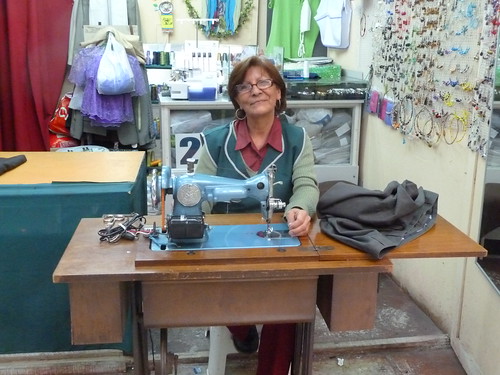
P1000953


This is Fanny. I thought she was using a pedal-driven sewing machine, which she is, but it's got an electric motor retrofitted onto it. I asked if I could take a picture, and she started to get up.
"Oh, can I take the picture with you?"
"Of course! I thought you wanted a picture of the machine."
"What good is a machine without the person who uses it?"
Which she happily told her colleagues as I left. I think that modern technology does so much to change our lives so quickly, and so much of it is incomprehensible without special training, that we feel like Technology is something inhuman. But the word "technology" comes from the Greek téchnē, which means "art," "skill," or "craft." Setting aside non-human tool-using (which is significant, but not our problem), Technology is the stuff we make, as humans, and it has no meaning or purpose apart from human beings. We're in charge, and if it doesn't seem like it, it's because we're looking at things all wrong. We forget how important we are, because it's scary.

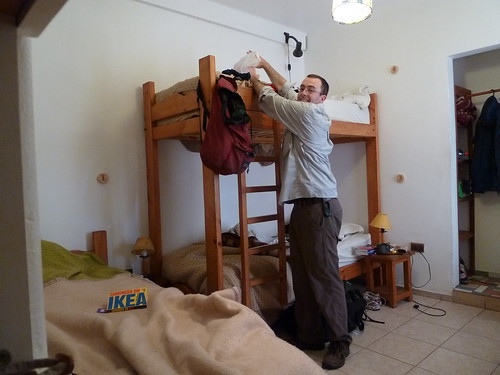
For the past two nights, I've had the World's Worst-Designed Bunk Bed:

obnoxiously tall bunk bed

Notice that I can neither see nor manipulate things on the bed, so in the room I have nowhere to organize my stuff. Note also that the ceiling is like 11 feet tall. Who the hell needs 5ft of clearance in the bottom bunk? Luckily, tonight I'm moving to a private single room, since that's what was available. That works better with my "Cocaine and Hookers" evening plan, anyway.

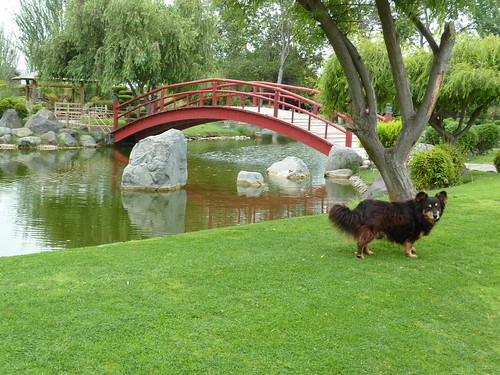
For some reason, La Serena has a Japanese garden! It's small, but in a country that could give two shits about Japan, it's pretty amazing that it's here at all. This picture just screams CHILE at me:

P1010010

Yes, that's a Japanese garden pond and bridge. And someone's random dog wandering around.

The ever-increasing set of La Serena photos is here at Flickr.

Monday, June 28, 2010

back in the old days

At Danger, we had a team of about thirteen people, each responsible for one or two different servers. All the servers running together is called a "service", which provides all the functionality for the Sidekick: data storage, instant messaging, web browsing, email, etc. Keeping all of these things working in sync is, as we geeks say, "nontrivial." Bugs internal to each server--say my data server is crashing if it gets too much data--are compounded by bugs in how the servers interact: I fixed my data server problem, but now it outputs data slightly differently and the mail server can't handle it. It starts out looking like a mail server bug, but in reality it's a bug in the communication between the two servers. The sane way to manage this problem is to put your code through constant functionality and interoperability testing, releasing it as often as you can (iteration) and always putting all the parts together (continuous integration). So every day we "rolled" the previous day's code out to a developer service that all the engineers and most of the other tech staff used, called "Daily". Because we used it, we usually noticed immediately if it was broken and we were responsible for fixing it. One rainy day in my first year, I meandered into the office at my usual early hour, about 8 A.M., and ran into another Chris, the head of IT, who informed me that the network was down on the engineering floor, due to flooding in the network closet.
This was a three-story building.
"We're having a flood on the second floor?"
"Yeah, leaking through the HVAC vents. Water was cascading down the equipment rack, it was great. There's a tarp over it now, we'll see if it dries out okay."
"A tarp."
"Yep."

Only TJ was in the office. TJ is, to put it mildly, a diligent worker, and yet there he was in the corridor, not working.

"Hey, TJ." "Daily's down. I would have sent email, but, well, Daily's down."
We investigated. Daily shouldn't have been down, because (we thought) Daily's machines were in the nice, dry server room on the first floor. We'd worked really hard to make Daily be reliable in that way. And it was mostly true. The team had a double cubicle partitioned off, with a couch and a wheeled shelf/drawer converted to a liquor cabinet, and a coffee table of sorts, with legs made of two standard beige-box computers, x86-a and x86-b. In the old office, both had been damaged by hallway soccer years earlier, and we assumed they were both turned off, though we couldn't actually tell because the power lights were broken and we were too lazy to check the fans in back. As it happened, x86-a had a shared drive, containing...the Oracle database libraries. Which were needed by the data server. Which was running in the first-floor server room. Which couldn't talk to x86-a, which was up on the second floor, with its flooded network closet.

TJ and I got out a deck of cards and played Hearts for an hour or so until things were fixed.

Computers are hard.

travel tip: power adapters

Appliances I brought to use in Chile's 240V power outlets:
  • electric shaver
  • netbook computer
  • battery charger
Number of 240V->120V power transformers I use:
  • none
My battery charger cost all of US$7 and it auto-switches, so apparently sometime in the past 15 years, someone figured out how to make cheap, lightweight auto-switching power supplies.

To figure out if your adapter auto-switches, read it! It should have a line that says "INPUT," followed by "120VAC," and if it also says "240VAC," you're all set, you just need a plug adapter.

Saturday, June 26, 2010

fear of technology

Trevor Maloney, one of not-very-many Zen priests in Houston, was bothered by a piece in the New York Times about the Singularity, the idea (with variations) that eventually we'll all upload ourselves into computers and, to quote the Heart Sutra, be "freed from all suffering and distress". Whatever.

The article and comments have a flavor of anti-technology-ism that I've always found strange, and grounded in a lack of understanding of what "technology" is and how it fits in the human experience, and underneath it all, some amount of fear that comes from the lack of understanding. My little brother felt the same way during his hippie phase, and I get it sometimes from the less-technical people in my sangha back home.

"Technology" is a catch-all term for the tools we humans make. Computers are technology, and so are steam engines, irrigation ditches, and the wheel. Not only do we make stuff, but we make stuff to help us make stuff. It's a big part of what we are as a species.

When I worked Tech Support in college, I learned that a lot of people view computers as some kind of alien artifact, and they abandon all common sense as though there were no point in trying. I wonder if it's similar to math anxiety, because I watched otherwise intelligent people behave as though they didn't understand that computers require electricity.

(I'm not joking. The first question on the phone is always "Is it plugged in and turned on?", and that comes from experience, not because we're trying to insult you. Any tech support story that you hear, where a user acts with a seemingly impossible stupidity? I guarantee it's real.)

Here is the deep, dark secret about computers:
They are exactly like your toaster.
They obey the same laws of physics, require electricity to operate, and have the same level of human consciousness and volition. They're not out to get you. They are not the source of the world's problems.

I'm particularly startled and saddened to see serious students of Buddhism indulge their technophobia, because a big part of the Buddhist premise is precisely that dukkha (dissatisfaction/discomfort/suffering) is a universal human experience, throughout time and across cultures: I think that once you understand what dukkha is, you can quickly find it wherever and whenever you have people. Furthermore, the responsibility for creating and ending our dukkha is ours alone. Saying that technology somehow makes it worse takes away some of our responsibility, and plays into our ever-present desire to imagine that our dukkha comes from external circumstances, and we can't possibly change it.

Now that I think of it, that temptation to dodge responsibility is so strong that I'll probably be ranting about this until I die.