Showing posts with label culture. Show all posts

Sunday, September 4, 2011

reveling in uncertainty

One lasting effect of my time in Chile is a stronger sense of relativism: of just how arbitrary cultural norms are. I have a much better sense of how strongly cultures can differ on points that initially seem really important, and how the set and sequence of what matters in Culture A can be more or less orthogonal to what matters in Culture B.

Let's illustrate this with two social-religious issues: divorce and gay sex.
  • Divorce in the United States has gone state by state, but a brief scan indicates that Maryland legalized it in 1701, while South Carolina legalized it around 1949. Chile legalized divorce (fault-only) in 2004, and no one uses it: they just separate and go start families with other partners.
  • Chile legalized gay sex, by repealing the laws, in 1994 (yes, 10 years before divorce). Many American states never actually legalized it: Lawrence v. Texas struck down all the sodomy laws in 2003, but states only rarely bother to repeal laws rendered unenforceable. (Especially if, like the American South, they're a little cranky about the law being struck down and they want to leave it on the books as a middle finger to the Supreme Court.)
Abortion is illegal in Chile, with no medical or rape exceptions. It's tempting to think the country is a right-wingnut's dream, but pre-marital sex is ubiquitous, and teen pregnancy is generally treated cheerfully. It's a tolerant society; they just tolerate different things, at different rates of change.

A couple weeks ago some of us at work were chatting about our various migrations around the country, and I was explaining to one of our interns (whose parents are Taiwanese!) that Chileans tend to stay within a 20-minute drive of their family, and if that impacts their career, they're generally okay with that, because the family is what matters to them. Furthermore, Chileans who do leave their families behind often face significant pressures to come back. He wasn't getting it.
"Wait, so they just...take whatever jobs are near where their family is?"
"For the most part."
"They're happy like that?"
"Of course. They're living according to their values. If they weren't happy about it, they'd do something else."
"That's...weird."
This doesn't mean that we can't have values. There's a small raft of things I won't tolerate at all if it's in my power (rape, torture, slavery), and then a somewhat larger raft of things I disapprove of but I recognize exist more reasonably within their cultural context: like teen pregnancy in Chile, which hinders girls' prospects for a better life, but because of their tighter-knit family fabric, it's a more manageable thing than here. Or veiling women in the Muslim world, which you can write many books about, itself having many contexts, some good, some bad, some just very alien to us generic whitebread Americans.

Most cultural differences, though, just aren't that important once you start looking at them. Chileans eat horrible, awful, boring food as a matter of course, but it's still a beautiful country full of perfectly friendly people. Their map of social dishonesty is different: they can't say "No" to a request, and we can't say "You're looking fat today". It's not really possible to say that's a terribly important difference, and to have relationships there, you really have to open up and accept those differences.

Here's where this can change everyday life.

If those differences are not very important between cultures, it follows that they're not really that important within a single culture, either. If you learn to accept vast differences when you're embedded in a different culture--when you have no choice, if you want to have relationships and participate in that society--then you've already re-wired yourself to let go of things you thought mattered but actually don't. You can meet someone who disagrees with you, or that you have a negative reaction with, or whatever, and instead of thinking, "This person is a jerk" the way you would have thought, "Holy crap, Chileans are insane" (which they kind of are but I totally have anecdotes to back that up, and Chileans don't disagree), you can think, "Huh, this person and I aren't getting along. I wonder why?" and you can start out by asking questions instead of making judgements.

Most of us need to be less sure of our judgements, and living abroad is an excellent way to do that.

Friday, December 3, 2010

beginning re-entry

I had a dream last night about completos, those nasty heavily-dressed hot dogs they serve here. In my dream, they sold them at an American school, like they sell them in schools here, but it was Americanized and looked like it was chicken curry in a hot dog bun. And a student slipped one in her pocket.

I'm starting to line up phone screens, and I'm nervous because:
  1. My head's not exactly in the space of solving computer problems, and
  2. I speak very slow and simple English, as if I'm speaking to second-language learners.
I catch myself thinking in Spanish, and I'm really good at catching myself, but once I'm yammering about software problems, who knows.

Also, even though I hate the food here and will be happy to be rid of various other things, I'm used to them.

This is gonna sting a bit.

contrarian

Answers you might not expect.
  • Chilean food is overwhelmingly boring. I know, we think of Latin America and we think "Spicy!", for both the people and the food. Most of our experience of Latin food is Mexican food, or maybe Central American. You'll be even more confused if you've had Peruvian food, which is flavorful. And it's true, Peru is right there on the northern border (albeit a couple thousand miles from where I am in Chile right now). However, Peru and Chile hate each other. And in Chile, the word for "spicy," picante, also means "low-class" and "tacky." Anthropologist Jim Stuart explains why.
  • The best thing about Chile was an empanada shop. Everyone expects something deep about this question. But my mind doesn't really work on linear-scale absolutes. Empanadas Las Tablas (Calle Ecuador in Vina del Mar) really is that good, and I talked a lot with the owner, Juan Pablo, who used to be a cop and went on a government-funded junket all up and down the American East Coast. The empanadas are so good that I pretty much got at least one every time I was in town, which was at least 3 times a week for aikido.
  • I don't like Dr. Bronner's liquid soap. My friends all love it, but I've traveled with it quite a bit now, and I hate it. It's difficult to lather up, and it leaves my hair brittle and my skin dry, and I don't really feel clean. Fine for washing clothes, but ugh.

Friday, November 26, 2010

that's a wrap.

This morning we had the English Opens Doors closing ceremony over at the UN building on the far, far, far eastern edge of Santiago. It's down the street from the U.S. Embassy, located in the middle of nowhere because that's where they could find 5-10 acres. There were several speakers; it would have been nice if the Chileans spoke to us as though Spanish were our second language, instead of full-speed Chilean. (The room had about 9 Chileans and 100 native English speakers, so they weren't exactly responding to their audience.) A couple of volunteers spoke, which is totally fine, except that the Ministry of Education was filming the whole thing, "to motivate future volunteers," and the volunteers' stories were...not exactly motivating. The guy's was, more or less, though he also talked about the exhaustion; the girl's was almost harrowing, since she went through 3 host families, one of which included a father who was sending her inappropriate text messages late at night. (It's bound to happen to someone, with dozens of attractive 20-something American girls living with host families in a macho country.)

I understand that she had a rough year and it's possible she couldn't keep herself from talking about it. She was trying to put the best face on it she could, but in fact she was down in Punta Arenas or something, at the end of the Earth, in a failed school system, with bad host families. There's only so much you can do to spin it.

Listening to many of us, it can seem like the frustrations of our time in Chile have outshined the good stuff. I don't know that it has: it's just that it's easier to rant about frustrating things, and those are the things that have taken our energy and left us ready to move on. And let's face it: we want to be interesting and engaging when we talk, and that's a lot easier when talking about the negatives. Positive things are easy: my host family loved me, the people are kind and generous, I learned (more) Spanish! There's not much mystery there.

The negatives, though, are ripe for discussion. They frustrate us, they wear us down. Why don't Chileans listen and respond to the actual words you're saying? Why is the food so bad in a country awash in cheap, high-quality ingredients? Why does your host family yell at you for not wearing shoes, because that's how you get pneumonia? (Alternately, it's the change of temperature, or you haven't been wearing a scarf, even though it's almost summer. The idea that disease is caused by germs rarely comes up, though they'll allow it when pressed.)

These things are interesting because from our point of view, they're absurd and strange and inexplicable. They're implacable obstacles to the smooth functioning of our lives in this culture. Incredulous that this was for real, we probably bashed our head against the wall trying to change it--"No, I really genuinely honestly do not want fried hot dog slices in my rice"--before developing the necessary mix of acceptance and resignation. We never quite like it, though: like a stone in our shoe, eventually it causes some bruising or blisters. Even if we look back and tell the stories with humor and love, that comes from perspective on an unpleasant experience. In addition to making it easier to be funny and interesting--this is why film or theater critics can get carried away writing bad reviews--talking about the negative stuff lets us process it more thoroughly. It's cathartic, and gives us some distance on it. We can start to associate those things with laughter instead of self-control and forced patience.

I'll try to keep the stories balanced as I unwind over the coming months. Just remember, I'm not the sunshine-and-roses type. It was an excellent experience, and it was the thing for me to do and it was amazing. But: I've done a number of very difficult things in my life, and this was the hardest. I think a lot of volunteers would probably say that, so keep it in mind as we rant about the difficult things.

Tuesday, November 23, 2010

La Serena

I've been soaking up La Serena, by which I mean "wandering about drinking coffee and eating non-Chilean food while I take pictures of churches with weird aspect ratios." I find myself comparing it to Chillán and Valdivia, which reminds me of what Tyler Cowen said:
If you set off to a mid-sized city in South America -- especially in the Southern Cone -- your chance of finding an idyllic spot are high. There may be, in a way, nothing to do there, at least not in the sense that your guidebook can report. But it will feel so fresh, so undiscovered, so representative of the vitality of everyday life, that you will at times think you have stumbled upon paradise. Everyone there will seem so apart from the world you know and there is a sudden (and quite silly) shock at seeing how seriously they take the world they know.
I wouldn't say that people down here seem apart from the world I know, at least at first, but there are some things--their mental distance from World War II, the fact that Christmas is in the summer, that the school year doesn't cross the calendar year, that the sun is in the north in the winter instead of the south--that remind me that they're completely accustomed to completely different things.

At any rate, Chillán is not someplace you'd normally visit, but my brief pass through left the impression of a low-rent, industrial, un-scenic Valdivia or La Serena.

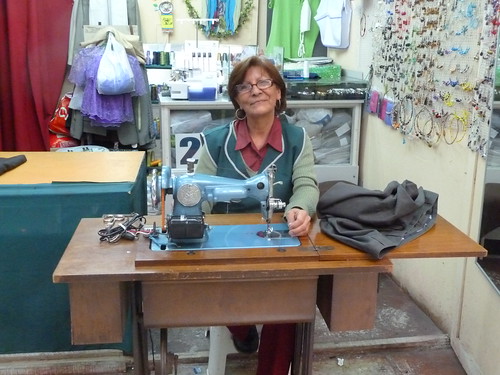
P1000953


This is Fanny. I thought she was using a pedal-driven sewing machine, which she is, but it's got an electric motor retrofitted onto it. I asked if I could take a picture, and she started to get up.
"Oh, can I take the picture with you?"
"Of course! I thought you wanted a picture of the machine."
"What good is a machine without the person who uses it?"
Which she happily told her colleagues as I left. I think that modern technology does so much to change our lives so quickly, and so much of it is incomprehensible without special training, that we feel like Technology is something inhuman. But the word "technology" comes from the Greek téchnē, which means "art," "skill," or "craft." Setting aside non-human tool-using (which is significant, but not our problem), Technology is the stuff we make, as humans, and it has no meaning or purpose apart from human beings. We're in charge, and if it doesn't seem like it, it's because we're looking at things all wrong. We forget how important we are, because it's scary.

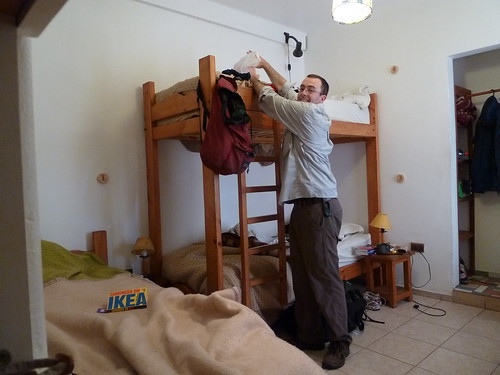
For the past two nights, I've had the World's Worst-Designed Bunk Bed:

obnoxiously tall bunk bed

Notice that I can neither see nor manipulate things on the bed, so in the room I have nowhere to organize my stuff. Note also that the ceiling is like 11 feet tall. Who the hell needs 5ft of clearance in the bottom bunk? Luckily, tonight I'm moving to a private single room, since that's what was available. That works better with my "Cocaine and Hookers" evening plan, anyway.

For some reason, La Serena has a Japanese garden! It's small, but in a country that could give two shits about Japan, it's pretty amazing that it's here at all. This picture just screams CHILE at me:

P1010010

Yes, that's a Japanese garden pond and bridge. And someone's random dog wandering around.

The ever-increasing set of La Serena photos is here at Flickr.

Sunday, November 14, 2010

snail cream

The little stalls that sell various herbal concoctions and natural beauty care stuff also sell crema de caracol. This means, literally, "snail cream," and it's got a picture of a snail on it. Everyone says it works wonders on scars and stuff. But why "snail cream"? Is it made out of snails? Strange, gross, but hey, who knows. There's a snail motif in Chilean culture that crops up occasionally: Hostal Caracol, where we've stayed a few times, and a couple of galerias with "caracol" in the name, since they're winding, spiraling ramps up the inside of a building (filled exclusively with hair salons and video game parlors).

I finally asked a vendor, who was very friendly and happy to help. It's not the snails themselves: it's snail slime.

I guess that's better.

Tuesday, November 9, 2010

the new normal

A few weeks ago I finished reading Jeffrey Eugenides' Middlesex, which is an excellent book (if a little meandering). Among other things, its detailed description of growing up in the 60s and 70s gives me flashbacks to being a kid in the 80s.

I'd hate to oversimplify that time. Our memory lies, and nostalgia lurks in dark corners like a dormant virus, waiting to corrupt our experience of the present. I do think it was a less chaotic, freewheeling time, though, at least in retrospect. (Our view was just limited for how far things could go, sort of like we thought conservatism had reached its apogee of evil stupidity under Bush II, until we saw what came after.) We had reference points; not healthy or productive ones, but we knew where we stood, or thought we did, which made us feel almost as good. Our enemies and adversaries were easily-identified nation-states (remember when Libya mattered?). The order of the old world hadn't yet completely disintegrated. The nation was still arguing about Vietnam, a festival of recrimination we would continue until President Obama's election in 2008.

(Finally, no one cared what a candidate had done during the war, because mostly he was being a little kid in Indonesia.)

We had structure, we had defined roles and categories. Those are reassuring things; much like what we provide for/force upon children. The structure of the world limited and blinkered us as much as it supported. Like any culture, if you didn't fit the provided roles and categories, you were going to have trouble.

When I was a kid, if you had an earring in your right ear instead of your left, it meant you were gay. As for the kind of bizarre feminization implied at the time by having earrings in both ears...better not to speak of it. But that was it, that was the signal. I don't know if it was real or not, but in our childhood culture, it's not something anyone wanted to risk. (It could well have been real. Gay men have had to use such covert signals for centuries, to survive.) When I pierced my (left) ear in 1991, it wasn't exactly cutting edge, but it was also not universally accepted. Piercing the right ear in 1996 or so felt slightly edgy, probably the closest I've ever come to that hip state of social rebellion.

Can you imagine that kind of coded distinction from today's 10-year olds, born in 2000? They're far more likely to say "you're gay if you primarily like dating the same gender as you." It's not a thing for them. And it's not just us over-educated latte-sipping poofs in the coastal cities. This Slate article about Constance McMillen, the Mississippi high school senior who filed suit to be able to bring her girlfriend to the prom, contains this gem of a paragraph:
And Constance herself is the kind of young woman a state entirely mired in bigotry can't produce. Though she doesn't belong to a church, McMillen describes herself as an "open-minded Christian" and a strong believer in monogamy, which she expresses in a distinctly evangelical way. "Actually, I have a promise ring from my girlfriend, and I'm pretty sure that within the next year she's going to propose. Of course, we wouldn't get married until she's 18." One male student once asked McMillen's girlfriend, "How can you be redneck and gay at the same time?" which seems tantamount to proof that the woman in front of him had that figured out. McMillen would like to live in Los Angeles when she gets older, but that is due in part to many, many hours spent watching The L Word. Her girlfriend says she doesn't want to come because she can't hunt there.
Between that and a black President, no wonder the American right has completely lost its mind. Every month brings more evidence that the old world is passing away, the world of obvious enemies, and women and minorities who "knew their place." By 2050 if not before, we'll technically all be minorities. (Though probably not women. Not even in San Francisco.)

Ever since I was a kid, I have listened incredulously to my mom's stories of "dorm mothers" at all-female Smith College in the 60s, older women who watched over the students and enforced curfews and behavior. Decades before going to college, I absorbed that such a thing was absurd and impossible in my time. It only seemed more absurd when I went to college and visited Smith several times. In the 90s, at least, Smith had a circle-the-wagons mentality about men, a protectiveness of women for each other, as if the culture was dominated by 1500 of your ex-girlfriends, but only the ones who were still mad at you. Who needs dorm mothers when every girl has a posse of bodyguards (many of whom were bigger than me)?

Just as dorm mothers sound impossibly quaint to me, so must the earring-as-gay-identifier sound quaint to today's young people. It sounds quaint to me. The numbers agree: here's a breakdown of approval of gay marriage by state and age (click image for original website).
The red dots are people aged 18-29, and the blue dots are people over 65. It's a perfect correlation, with no exceptions: the older you are, the less likely you are to approve of gay marriage. So, it's a done deal: as my subculture started saying as America considered choosing its first post-Vietnam President, we're waiting for some people to die so life can move on. It's a harsh way to put it, but it's true. And yes, we'll still say that when we're old, even if we're the ones in the way.

There's no guarantee we won't backslide. We often think of history as inevitable, because we look at what happened, and we think. "Look! The past only happened in one way! And here's why! It had to have been that way." We're fantastically wrong: just like we don't know what will happen in the coming year or two, neither did anybody 50 or 100 or 3000 years ago. History is full of unrealized paths. Just because conservatives have eased up on hating gays in favor of hating immigrants and Muslims doesn't mean it won't come around again.

But the demographics look pretty awesome.

Tuesday, October 26, 2010

what are we doing here?

Greg, a volunteer down in Punta Arenas, has a wonderfully-titled and well-written post called "The Novelty Has Simply Worn Off."
In this situation, I never expected to be an afterthought. At that point, it feels like we're all kind of missing the point of me being here. I came to make kids excited about English, to expose teachers to new ideas of how to teach and to exchange cultural experiences and traditions with my family and community. As we press on through these last weeks, I feel that much of that has been tossed out the window. I'm not the new, exciting person that just showed up one day. I'm just part of the scenery now which certainly represents my cue to find an exit.
I see what he's talking about: I've been part of the routine at INSUCO for a while now. Two things strike me about that:
  1. It's inevitable. Novelty is unsustainable by definition.
  2. It's a good thing.
The lack of novelty means that everyone has changed and adjusted. My kids are used to me! I'm pretty offbeat even for a North American, so it took some time. We have really good relationships, where they like me (with one conspicuous exception) and know I care about them. I've adapted to them, sure, but I didn't have as far to go, because I have no experience with large groups of 15-year olds, so if they happened to be Chilean, well, whatever.

They, on the other hand, had to adjust to me, who:
  • Required them to participate: to talk and stand up and move around.
  • Forbade cell phones and eating in class.
  • Checked to make sure they understood stuff.
  • Took time to make them say things when they had trouble.
  • Didn't make them--didn't let them--write anything down.
  • Had no compunction about doing silly dances or making chicken noises in class.
That's all completely different from their experience, where they have to shut up and copy stuff down all the time and they get to check out and eat and wander around the room. And Chilean teachers do not, as a rule, make chicken noises.

And I got to be the Non-Parental Adult Who Cares. I tried to see them and accept them for who they are, while I push them to do things they were embarrassed about, and encourage them to act as adult as they can manage.

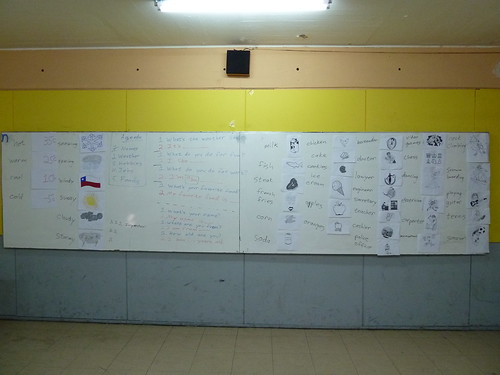
The WorldTeach orientation set my expectations pretty well. English education here is broken five ways from Sunday, and I had no illusions that I could fix it, fight it, or even teach a whole ton of English. This, for example, is what we've done this semester: 41 words and 4 questions/responses.

this semester's work

What they learned with me won't help them on their standardized test, the SIMCE, which is unfortunately the government's metric for success. Even if they gave the authority to rewrite the school's curriculum--which would include revolutionizing their structure so that students could be grouped by level instead of a random set of 45 kids all having the same classes--I don't know anywhere near enough about ESL/EFL education to know what to do.

I don't know that any of my kids are more motivated about English now; honestly, I doubt it. But they know they can learn at least a little bit of it, and that some random person from far away showed up and cared enough to help them do it, and to me that's the important thing.

Thursday, October 21, 2010

marriage in Chile

I don't read or watch the news here: lack of interest leads to being too lazy to work through the language. So I haven't followed the miners' story at all, except for headlines, occasional bits in English, or Chileans asking me if I've seen the latest thing about the miners. As you may or may not know, the entire country has been watching and sharing every detail of the experience, and it's been a big focal point of national unity. When the first miner was scheduled to be pulled out, at midnight on a weekday, people set alarms and got up to watch. And continued watching for hours. And then went to work in the morning.

One thing I did catch was this juicy tidbit: apparently one of the miners was greeted at the surface by his mistress, rather than his wife. And then I heard a rumor there was a third woman looking to visit him at the hospital.

There are inevitable North Americanisms in the reportage about this--things that just wouldn't occur to you unless you spent some time digging into Chilean culture.

The first thing is that male infidelity here seems to be near-universal, and pretty much expected as part of the machismo complex. Every time I go to hang out with my friend Karen, Oscar and Ximena wink and promise not to tell Anna. And they're only sort of joking.

The women, for their part, tend to pretend cheating isn't ubiquitous among Chilean men, until their partner's cheating is in their face, at which point they feel really, really hurt; often the relationship ends, and if they form new relationships with other men, they continue to pretend cheating isn't ubiquitous.

The second thing is that no one gets divorced here. Divorce was only legalized in 2004, so for all these decades, people have been separating and remaining married, while moving on to find new partners and often start new families. I'd say about half the Chileans I've met who have ever been married are currently separated, whether or not they've got new partners. I finally asked one of the English teachers about this:
"Well, first of all, it's very expensive. There's paperwork, and you have to have witnesses, who say that this person did this thing--"
"Oh! You don't have no-fault divorce."
I explained no-fault divorce for him; he laughed when I got to the phrase "legal fiction," talking about how before no-fault divorce, someone in the marriage had to be abusive or adulterous in order to get a divorce, rather than the system just accepting the reality that relationships fall apart. You still have to do this to get an annulment from the Catholic Church: everyone gets together and lies and finds a reason the marriage was never valid to begin with. (Sheila Rauch Kennedy wrote a book about refusing to do this; her case is also discussed by Garry Wills in Papal Sin: Structures of Deceit.)

The expensive paperwork and lack of no-fault divorce is probably enough to deter most people, but the English teacher had a further explanation, chuckling:
"You know, the real thing is, not getting divorced keeps us from having to be married again."

what Chileans eat

During a discussion about trying to find a high-end pisco, Steve pointed me to this blog, Eating Chilean. There's a particularly fine post called "What Chileans Eat." He also did the research on the pepino I ate, a funky-looking striped fruit with the exact taste, color, and texture of cantaloupe (though he and his texts say honeydew, which is completely different, but whatever).

I'm not sure of the author's complete story: it sounds like he got divorced and retired from being a professor, moved to Chile, married a Chilean and started another family. Either way, he's enthusiastic enough to read historical primary sources about Chilean food, which is doubly interesting if you read Spanish. Anyway, check it out.

Sunday, October 17, 2010

communication failure: it's not just me

There's another aikido group that uses our practice space. They're Iwama, the same style as the dojo in Vina and the place in Valparaiso (now defunct again), only they're a lot nicer, and a couple of them, Blas and Frederik, even train with us pretty regularly. (This post has a rundown on aikido styles.)

I've chatted a few times with one of the guys, Rodrigo, and it's illuminating inasfar as he's very much of the "I want to do O-Sensei's REAL AIKIDO that WORKS ON THE STREET RAR" testosterone school. He also doesn't seem to listen to what I say, and carries no memory of our conversations from one weekend to the next. He always smiles slightly (it looks to me like a smirk) and says, "So how is Aiki-Zen?", which I guess is the name for what Jorge does, and I guess means something to Rodrigo, though not to me. Then he'll ask me if I've heard of "Real Aikido," which I think means these Serbian guys, and I say yes, I have, it seems like a reasonable, if violent, form of aikido, but I don't recognize it as anything wildly different from what I do. (Although apparently the guy styles himself the founder of his own art, which I view as pretty egotistical, but whatever.)

Then Rodrigo tells me about Iwama being the real aikido, not like Aikikai's soft flowing nonsense. Today I finally pushed back at him, because he was being an idiot.
"Right, but it's not what O-Sensei was doing for the last twenty years of his life."
"Yeah, but it's his real aikido."
"We have movies of O-Sensei doing aikido more like modern Aikikai."
"The movies weren't really what he did."
Seriously? Do you watch Fox News or something?
"Uh, my teacher visited O-Sensei's dojo and saw him. Another teacher in my association trained with O-Sensei for a few years. That's what he was doing."
"Huh. Well, maybe."
Then he continued on with talking about Real Aikido Techniques That Work On The Street, including demonstrating a technique on Frederik, an Iwama guy who trains with us sometimes. Finally, I stopped him.
"Look, I think you have this idea about what kind of aikido I practice. We've never trained together and we don't know each other well. But I don't think I practice in whatever way you think I train, so I really don't know what you're speaking to. Look."
And then I did the same technique on Frederik, handling his significant strength and force my way (which is not radically different from Rodrigo's way). Rodrigo said, "Yes! Exactly!", which made no sense to me, and I was happy enough for the conversation to be over.

Afterwards I had lunch with Blas, the Chilean Iwama guy who trains with us.

He said, "I have no idea what Rodrigo was talking about."

Thursday, October 14, 2010

aspects of comprehension

Today's English sentences I'm glad my students can't understand:
"Jesus Christ, stand up, you lazy bastards." (1-G)
"Holy crap, you guys are assholes." (1-A)
Don't get me wrong, both classes have been far worse. The rough-housing from 1-A is easier to deal with than more disruptive stuff.

I do get surprised. Students have varying levels of ability and comprehension, but I have to teach to the beginner level, because even the ones with better comprehension can't say much. In a more functional system, there would be assessment tests and students would be sorted out by level, but Chile's not there yet.

Gisselle rattled off something in Spanish for me, and I said, "Mas lento [slower]. If I say something long and fast in English, you're never going to understand it, are you?" And of course she got the wide-eyed complete-confused look that I had after her Spanish.

Suddenly the girl next to her, Jennifer, leans over and translates.
"Wait, you speak English?!"
"Mas o menos." More or less.
"No wonder you're always bored."
"Que?" What?
We chatted after class, and apparently her mother has always spoken to her in English and Italian. "No wonder" was beyond her and she wasn't inclined to demonstrate her speaking, but her understanding is obviously pretty solid, especially for Chile.

Who knows what else my kids know? And I'll never find out.

Wednesday, October 6, 2010

the priest at the Pyramid of the Sun

In October 2001,my girlfriend Mona and I crewed on a sailboat down to Mexico. This was The Bad Relationship, and the boat's owner was a selfish, passive-aggressive loon who eventually tried to kick everyone off the boat in the middle of nowhere, so the trip was a mixed bag. I did enjoy Mexico, though, and I came back with a raft of stories, including the time the four of us--me, Mona, the skipper, and his girlfriend--rented an old-school VW Beetle and did a road trip from Puerto Vallarta out to Teotihuacán and back.

Teotihuacán is hard to describe. It's an ancient Mesoamerican worship site, obviously, but it's...enormous. Huge. The Pyramid of the Sun, the largest structure, is 246 feet (75 meters) tall, which is at least 16 stories high. It has a lot of steps and takes a while to climb, and it's made of these tiny stones, 8-20 inches. And there are other buildings comparably sized, and then you realize that it's 2000 years old and we don't actually know who built it, and the mind reels.

Then you have to fend off the obnoxious guys pushing little stone statues to the tourists. Luckily they're either too lazy or not allowed to sell on the pyramids themselves, so if you gain some altitude you escape them.

We arrived there on December 11th, the day before the Feast of the Virgin of Guadalupe, Mexico's protector. Being godless heathens living on a sailboat, we hadn't noticed, and it took us a bit to figure out why there were all these Catholic pilgrimage tourist groups. This was their last stop before the gigantic festival in Mexico City the next day.

The first thing I noticed was a group of American Catholics standing in a circle, chanting some ritual I'd never heard before. There was the obligatory endless response of "Lord, hear our prayer," but the (non-priest) leader's lines were unfamiliar, and...unusually esoteric, somehow. It felt like it came out of the same dusty book as exorcism, and lived there, largely unused, for similar reasons.

The next thing we encountered was a Mexican guy who was pretty angry that a bunch of Americans had the temerity to come to a foreign culture's ancient religious sites and do some random ritual there. Mexican Catholicism has a strong streak of the original pagan in it, more than in many Latin American countries: this guy was there to do a solemn greeting to the four directions, and the next day he was going to dress up and perform in a giant traditional Indian dance in a plaza in Mexico City. So he was pretty miffed about pilgrims feeling they had the right to do some random thing on top of the pyramid.

There were a couple of priests with the group, and on the way down I caught up with one of them, a doughy heartland American in his mid-30s, from Wisconsin. We had a nice chat: it turns out there was a particularly zealous guy in the tour group, who asked the priests if they could do an obscure Catholic rite for purifying a space. Basically, they were asking God to forgive humanity for all the evil things (which I guess meant human sacrifices) that had happened on that spot. The priest thought it was a little odd, but wouldn't harm anything to humor the guy. Inasfar as you think Religion A coming and purifying Religion B's "defiled" ritual spaces might be a little arrogant, the Mexican guy's anger was right on target.

I saved several gems into my journal from the conversation with the priest, and someday I'll type them up, but it included one of my favorite lines ever, said without a hint of irony:
"Are you Catholic?"
"I was raised Episcopalian."
"Well, that's almost as good."

funeral Mass

My fellow teacher Glady's sister died early Monday morning of leukemia. There had been a couple other school-related funerals, and it had seemed strange several months ago for so many of the teachers to go to Pepe's mother's funeral--surely they hadn't known her? This time it finally dawned on me that it's the custom here for survivors' friends and colleagues to come to the funeral, and even to the cemetery, so I went. I guess that's what wakes are for in the States, though I've never been to one--there haven't been a lot of deaths in my life, and whenever friends' family members do die, the deceased always lived wherever my friend was from, not in the Bay Area.

It was pretty interesting. The cathedral was echo-y, but having grown up Episcopalian--"almost as good" as being Catholic, according to a Wisconsin priest I met on the Pyramid of the Sun--I had enough context for my Spanish to fill in the blanks and follow the service. The casket was open and laid along the axis of the nave, with a sign made of carnations (I think) saying in Spanish, "Goodbye, Friend." Apparently another custom is to bring a special kind of flower arrangement and lay them all in a line down the center aisle from the casket, which is pretty striking when you walk in. (I really wanted a picture, but my mother raised me right, so, no.) After the service, the mountains of flowers go to the cemetery to be put on the grave.

Another thing I noticed is how fast the funeral happened: Gladys's sister died around dawn on Monday morning, and the funeral was at 1pm Tuesday. In the States it takes 3 days just to tell everyone, and whatever other complications with undertakers and churches and cemeteries. (Luckily I haven't had to deal with it yet, but I understand it's a royal pain.) My grandmother's funeral was a week or so after she died, I assume to give everyone a chance to get to Long Island from our various far-away homes. Here, families tend to stay close geographically as well as emotionally, so I suppose it's easier to get everyone together quickly.

It seemed to mean a lot that I went, so I'm glad I did.

Wednesday, September 29, 2010

grrrr rip snarl

You all know very well that I'm not one to accuse people of being too observant. But really, after I've been communicating in good Spanish with you for 5 months, and conspicuously improving, is it really that surprising when I understand the gist of the conversation? Apparently so.

So in addition to not listening to me when I talk, people also seem to assume I don't understand what they're saying. Being dismissed from both ends is pretty rough, and I think this inner tension I feel--and the occasional snapping at people and raising my voice--is the long-forgotten feeling of being past the end of my considerable patience, off the reservation into Irritation, with forays into Anger. Not being heard is a particular raw nerve for me: there are a handful of people at home that I keep at arm's length because they're so wrapped up in the stories in their heads that I can't get enough of a genuine response (to my actions or speech) to feel like we're dealing with the same reality. It's really draining when people don't respond to who you are.

One of my teacher friends was further pushing me by insisting that I play and sing a song on the guitar at some gathering in 10 days. That's something that is hard for me even with a lot of practice, and (at least the way I received it) she not only refused to respect my unwillingness to do it, but she was making it out to be something that a "real friend" would do. She may just have been doing a standard Chilean thing that a Chilean would receive differently, but as I keep having to explain to people, and it should be pretty obvious at this point, I'm not Chilean. Sensing that I was about to raise my voice and get snarly to get my point across--and knowing that while she was pushing pretty hard, she surely wasn't doing anything mean-spirited--I took a breath, smiled, and said I'd see her later.

I'm home right now, writing about this, and listening to some sweet songs by the Wailin' Jennies, and suddenly I can see and feel how hard and spiky and tense I am right now, compared to how I am at home. It turns out that being open, patient, and gentle is completely unsustainable without a safe space to rest, open up, and be heard by other people.

We need each other. Who knew?

I still have patience for my kids: they need that from me, and I feel like they respond more clearly to the person I am, through the language barrier. But I've been shutting out the adults for the past several weeks, because I don't have any energy to meet them where they are, when I'm the only one trying to cover the distance.

This will pass. Everything does.

Sunday, September 26, 2010

Cartagena the janitor

One of the janitors at school is named Cartagena. There's something weird going on with me and the janitors, because a couple of times, one has said to another, "Heheh, that's Cartagena's friend," with a meaningful, knowing glance, and then they both laugh. Cartagena himself does seem to act a little odd around me.

Odd or not, I'm pretty sure he's lazy, based on what his boss has said and how often he cleans my classroom, which is never. If I find the boss and ask, he'll send someone by. Usually it's only a problem after school events, when my room gets used as a dressing room (which is totally okay, it's just full of trash afterward). Last week when I summoned someone to sweep up, Cartagena stopped by at the end of the day. (This is the best translation I can give. The janitors have a working-class dialect that I have a really hard time understanding.)
"Hey, the room's nice and clean, yeah?"
"Yes! Thank you, it looks great."
"You know, this room is supposed to stay locked, but you have to leave it unlocked so I can clean it." [My room is usually locked.]
"Yeah, but even when I leave it unlocked, you don't clean it."
"Well, you got me there!"
At least we've all got a sense of humor about it, and we both had a good chuckle.

(Curiously, at bemused moments like that, I feel like my father: often he will find a matter-of-fact humor in the most obtuse bureaucratic delays or maddening organizational inefficiencies. We talked a lot about government and politics when I was growing up, and at least once, when I expressed incredulity at some lunatic expression of American democracy, he just chuckled and said, "Well, no one does it quite like we do.")

Saturday, September 25, 2010

I am clueless

Lunch today was a chard soup, but something went wrong, and it was...wrong, somehow. Not inedible, but unpleasantly sour. It was fine enough with a bunch of salt and pepper, and the fried potatoes.

I was eating alone, and Ximena stopped in the hallway and asked how the chard was.
"Well, it's fine."
"Oh. Huh. Yeah."
"No, I mean, it's--"
"Ya, ya."
"It's fine with the potatoes."
"No, don't worry about it."
Dinnertime rolled around. Normally dinner on weekends is the same food as lunch, but there was a sudden new soup (which tasted as good as normal). Ximena put it on the table with her finger to her lips.

I looked at her quizzically. She kept her finger to her lips and made some waving sounds, as though I shouldn't mention it to Oscar. Though Oscar came in a few minutes later with a salad.

What just happened? Did I insult somebody or get overly picky? It seems clear they also knew something went wrong with the chard.

Who knows?

Thursday, September 23, 2010

priorities

My host family is pretty modern, by which I mean both parents work and nobody does anything together. That may be in part because it's a blended family that isn't very blended: Ximena's son Alvaro and Oscar's son Ignacio do hang out and play together, but however they work, the family relationships are decidedly not North American.

So we could theorize that people are just too busy to buy things like clothespins.

Or light bulbs.

Or laundry detergent.

It's not like anyone's saving money at the gringos' expense. We use, or would if they were stocked, the same household supplies the family does. Their clothes also fall off the line. They spent two weeks of evenings in the extremely dark living room lit by one dim bulb. They can't do laundry either (though of course they have more clothes here than we do).

Finally on Tuesday I decided to buy a pack of clothespins on the street. (The guy gringo'd me: I asked how much and he said "Two--three hundred pesos." I snorted and walked away, but I bought them at two-fifty, even though they were probably CLP$200, because really, it's a dime.) I told Ximena I bought clothespins, because I wanted to ask her about the lack of household supplies.
"How much were they? They're really cheap."
"250 pesos."
"Yeah! Really cheap."
"How come you guys don't buy them?"
"They get lost and broken, so I got sick of it."
"It's really confusing, the house things that you guys don't buy, like clothespins and lightbulbs."
[laughs] "I know! And I'm the mistress of the household!"
There's something extremely Chilean about that entire conversation. I think she just lets stuff not get done, the same way I do; with me, it's a couple years of tax returns (relax, I filed extensions and paid the tax, the government owes me money), and with her, it's clothespins.

Who am I to judge?

Sunday, September 19, 2010

Fiestas Patrias

Chilean recreation is a lot about "partying," which has always seemed a strange hobby to me, since I like my peace and quiet. (Yes, when I get home I'll be living with a half-time 6-year old, and it'll be a learning experience for both of us.) I don't like dancing, and I don't drink much, and I can't take large groups of people for long. Going out to nightclubs and bars is not a good fit for my temperament or interests.

Chileans, on the other hand, are highly social as a matter of course. In general, they love parties, and bigger parties are better. And so we get Fiestas Patrias.

Down on the south end of Valparaiso is the neighborhood of Playa Ancha, where the dirt parking lot of the soccer stadium becomes, essentially, the Chilean version of a county fair. One end has a midway with carnival games and rides, including a Ferris wheel. The other end is taken over by 3 rows of continuous temporary structure, about 100 yards long--the fondas and ramadas. A fonda is a little restaurant, and a ramada is a dance/performance hall, with a stage, dance floor, and drinks. Everything is covered in branches and slabs of tree bark: rama means "branch," so following Spanish's love of the past participle, something "tree-branched" is a ramada.

There were also several full-service liquor booths, where you could buy full-size bottles of liquor to bring into the pavilions, which have cover charges.

Steve and I went up there about 7:30 last night. It was nice, I guess; mind-bogglingly festive, and just starting to warm up and get really crowded when we left around 9:30. A few people had recommended the transvestites' pavilion, so we went there, and they weren't passable, but they were pretty funny.

(It's a pretty funny thing to hear the 76-year old house grandmother muttering, "Oh, yeah. The transvestites. They're so nice!".)

Reasonably interesting, reminded me of the Big E back east, and very Chilean...but not really my kind of thing.

Regardless: Happy Birthday, Chile!

Saturday, September 11, 2010

the Chilean evening schedule

I met up with Corrie for dinner in Vina del Mar: she hitched a ride with her friends from Calera, Edgardo and his 6-months-pregnant wife Kati. Then it turned out that volunteers Lauren and Allison, with respective boyfriends Jorge and Marcelo, also showed up. We had a lovely actually-Italian meal at a cute reasonably-priced restaurant off in an alley.

Then around 10:30, we headed over to a pub owned by one of Kati's friends. I left my backpack in their car, saying "I can only stay for one drink."

"Oh yeah, us too," says Marcelo.

I ordered a gin & tonic, which came with the typical 3 shots of hard liquor in the glass. Marcelo and Kati had to leave relatively early, around 12:15--after all, they were dropping me off in Valparaiso and then had a 90-minute drive back to Calera.

I had a lovely time, but oy, their party schedule.