Thursday, October 28, 2010

testing and tears

1-J had their test scheduled for today, and yesterday they started campaigning for me to delay it. They claimed they had my test, another test, and a Biology project due all today, and the rules said they don't have to have more than two tests in a day. We had a similar rule in college about exams, but of course I don't have the language skills and contextual knowledge to know when the kids are trying to con me--although they usually are. They were genuinely distraught; yesterday I told them I'd think about it, but they should be ready for the test. I said they should talk to the U.T.P., the Unidad Técnica Pedagógica, which is literally something like "Educational Technique Unit," and I translate as "Curriculum Director," because they're the school's academic overlords. A couple girls said they'd do that.

Today they campaigned harder, and of course no one had actually talked to the Curriculum Overlords (perhaps thinking they had a better chance with me alone), so when they came to my classroom, I said, "Okay, let's go talk to the U.T.P., the rest of you hang out here." I don't know the rules of the school very well, it'd be a pain for me to delay the test, and I didn't like the power dynamics of me making the decision--of either giving in to a silly student demand (they knew the test was coming and we prepped for it last week), or of their perceiving an injustice if I remained hard-nosed.

Funny enough, the three students went in to talk to Uberlinda, the Power-That-Is, and when I showed up a few steps later, her assistant Claudia basically blocked the door and asked how she could help, so I had to say "I'm with them" to get in to watch the conversation.

Uberlinda told them they were SOL: that yes, they can only have two tests in a day, and that's all they have, the Biology project is something they're supposed to do at home, well before the day it's due. So we went back to the room and crushed everyone's hopes and started the testing.

The test was two parts, equally weighted: give me the English words for 10 pictures, and then ask me 3 of the 4 questions we learned (things like "What do you do for work?" and "What's your favorite food?". I'm pretty generous by American standards, and I try really hard to help the kids get at least partial credit, by prompting them with initial consonants and stuff. Even so, we had a few bad results and one set of tears, and several requests for a way to raise their grade.

In a school where their learning experience were reasonable (especially if I were creating it), I'd say "tough," but...a lot of these kids already have lousy grades in English, and if they don't keep their grades up, they'll get booted out to another school. I know for a fact that these are smart kids, and most of them aren't any lazier than normal 15-year olds; and I know that between the huge, untracked classes and bad curriculum, their overall English-learning experience is crap.

Maybe they'll succeed under the Chilean system, maybe they won't; but I think I want to help them as much as I can while being fair to everyone and still insisting that they be assessed on what they know.

Tuesday, October 26, 2010

what are we doing here?

Greg, a volunteer down in Punta Arenas, has a wonderfully-titled and well-written post called "The Novelty Has Simply Worn Off."
In this situation, I never expected to be an afterthought. At that point, it feels like we're all kind of missing the point of me being here. I came to make kids excited about English, to expose teachers to new ideas of how to teach and to exchange cultural experiences and traditions with my family and community. As we press on through these last weeks, I feel that much of that has been tossed out the window. I'm not the new, exciting person that just showed up one day. I'm just part of the scenery now which certainly represents my cue to find an exit.
I see what he's talking about: I've been part of the routine at INSUCO for a while now. Two things strike me about that:
  1. It's inevitable. Novelty is unsustainable by definition.
  2. It's a good thing.
The lack of novelty means that everyone has changed and adjusted. My kids are used to me! I'm pretty offbeat even for a North American, so it took some time. We have really good relationships, where they like me (with one conspicuous exception) and know I care about them. I've adapted to them, sure, but I didn't have as far to go, because I have no experience with large groups of 15-year olds, so if they happened to be Chilean, well, whatever.

They, on the other hand, had to adjust to me, who:
  • Required them to participate: to talk and stand up and move around.
  • Forbade cell phones and eating in class.
  • Checked to make sure they understood stuff.
  • Took time to make them say things when they had trouble.
  • Didn't make them--didn't let them--write anything down.
  • Had no compunction about doing silly dances or making chicken noises in class.
That's all completely different from their experience, where they have to shut up and copy stuff down all the time and they get to check out and eat and wander around the room. And Chilean teachers do not, as a rule, make chicken noises.

And I got to be the Non-Parental Adult Who Cares. I tried to see them and accept them for who they are, while I push them to do things they were embarrassed about, and encourage them to act as adult as they can manage.

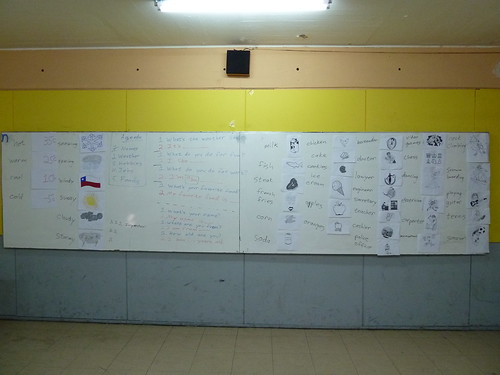
The WorldTeach orientation set my expectations pretty well. English education here is broken five ways from Sunday, and I had no illusions that I could fix it, fight it, or even teach a whole ton of English. This, for example, is what we've done this semester: 41 words and 4 questions/responses.

this semester's work

What they learned with me won't help them on their standardized test, the SIMCE, which is unfortunately the government's metric for success. Even if they gave the authority to rewrite the school's curriculum--which would include revolutionizing their structure so that students could be grouped by level instead of a random set of 45 kids all having the same classes--I don't know anywhere near enough about ESL/EFL education to know what to do.

I don't know that any of my kids are more motivated about English now; honestly, I doubt it. But they know they can learn at least a little bit of it, and that some random person from far away showed up and cared enough to help them do it, and to me that's the important thing.

Monday, October 25, 2010

a transplant experiment

I stayed at a certain hostel here where the manager is a middle-aged American woman. She runs an outstanding place, and has lots of interesting stories, but she's one of the majority of non-corporate expats who have...issues. Vaguely defined. It takes certain personality traits to go move yourself permanently somewhere else; for lack of a better word, expats who aren't set up by a big organization (e.g. company job or diplomatic corps) are usually somehow flakey.

She had brought her teenage daughter here some years ago and put her in a Chilean public school. I could barely conceal my shock: my eyebrows rose, as though possessed. I'm not of the opinion that you have to sacrifice everything to give your children the best of everything, but I am definitely of the opinion that you should sacrifice as much as you can to give your children the barely-adequate of everything. Choosing to put your kid in a Chilean public school, when you have better options, doesn't qualify.

I got my eyebrows under control and continued the conversation.
"Well, I wanted her to experience being around kids who didn't have as much stuff."
"That's a good idea. How did that go?"
"She came home one day and boasted that she was getting sevens." (Chilean grades go from 0 or 1 up to 7.) "I said, 'How are you pulling sevens? You don't even speak Spanish.'"
Ooookay, so you put your child into a barely-functional school system where she doesn't speak the language and there's no facilities for teaching it to her.
"So what happened?"
"I took her out of the school when she came home one day and said she had to go meet her friends to graffiti some stuff."
I say "parenting fail," despite the broadened cultural horizons. (As of our meeting, the daughter hadn't been heard from for several months, which Mom thought meant she was dropping out of college, possibly not for the first time.) What do you think?

attrition

My school maintains its academic and behavioral standards in part by kicking kids out. Usually the other kids tell me when I'm taking attendance using my popsicle sticks with the names on them--leading to the dramatic moment where I take a student's popsicle stick, break it half and toss it in the trash--but sometimes Oscar remembers to tell me.
"Hey, you teach 1-G, right?"
"Yep."
"Well, two students are gone. Valero--"
"Ah, Marcelo..."
"And Pizarro."
"Karina?" (I have no idea if Karina is in 1-G.)
"No, Samuel." Oscar draws his finger across his throat. "Gone! Bad."
"Aw, but they were getting better with me."
But Oscar is already leaving the room. "Well, good."
They were problematic. I wonder if Samuel saw this coming: instead of his usual dark countenance, he's been open-faced and smiling the past couple weeks.

It's five weeks before the end of the school year. I wonder what happens to them.

impromptu whirlwind

Yesterday I went to a bingo fundraiser in Quilpue, for Heather's host sister. I won! Actually I won the first two times, but the second time I didn't realize you had to muscle your way in front of anyone else who won, so I missed out on a shiny brand-new 220V blender with a non-U.S. plug, which was disappointing. But look what I did win!


Now, now. Don't be jealous. Envy is a sin. I know you wanted hot pink fuzzy slippers and a combination pumice stone/brush for your feet.

I'd skipped the asado at Bennett's on Friday, but Corrie sent me a text message saying there was an asado at her place in La Calera, with a guaranteed soft thing to sleep on and I could go to bed when I needed, so I decided to do that. Of course, La Calera is nearly 2 hours from Quilpue, and I left at 8pm, but that's okay. It's been a long time since I took the last bus of the night out to some random deserted suburb, hoping I got the directions right. Especially with my cell phone not working. (I fixed it by rebooting, which eased things.)

The asado was lovely, with people being pretty accepting of my not dancing. In fact, everyone eventually migrated to the living room, and hung around talking. I got to tell my story about taking advice, and to refer to Chilean women as "dangerous," which always gets a solid laugh, for the kernel of truth in it; although, following the Advice Story, someone suggested complicado, which is funnier.

I'd met a young couple who live across the street, part of the extended family, Edgardo and Kathy. I think Kathy is Corrie's host cousin--hard to keep straight. Anyway, I stayed in their spare bed, which was nice, although it wasn't until I got there that Kathy mentioned that (a) the bathroom is in a building next to the house, and (b) they have dog who will bite non-residents, so if you're a guest, you need a resident to escort you to the bathroom. That wasn't exactly convenient after a night of carousing, but it worked out fine and I had a lovely time lounging around with them the next day.

Edgardo invited me to lunch at his parents' place down the street. I like spending time with them anyway, but having rabbit for lunch sealed the deal. The rabbit turned out to be "don't swallow the ammunition" fresh, with oregano and cumin, and there was also the best cazuela I've had in Chile, plus artichokes and salad. The family has bees and avocado trees, and Edgardo picked a few pounds of avocados for me.

They brought me to the bus stop and we watched the bus pull away, so Edgardo started racing to catch up to it, despite Kathy (8 months pregnant) and I suggesting I could just wait for the next bus. Then someone tossed a full beer bottle out the bus window, and they said, "Oh, that bus is full of angry drunks. Better wait for the next one."

Two hours later, I was home. Today: still a little tired.

Saturday, October 23, 2010

linkfarming

The Internet has been busy!
Finally, an awesome Atlantic piece about a meta-researcher who's busy proving the failures of modern medical research. It's of a piece with Michael Pollan's more specific discussion of nutritionism, since scientific food recommendations are driven by all this shockingly flawed research:
"Studies have gone back and forth on the cancer-preventing powers of vitamins A, D, and E; on the heart-health benefits of eating fat and carbs; and even on the question of whether being overweight is more likely to extend or shorten your life. How should we choose among these dueling, high-profile nutritional findings? Ioannidis suggests a simple approach: ignore them all."
Or, put another way: "one large randomized controlled trial even proved that secret prayer by unknown parties can save the lives of heart-surgery patients, while another proved that secret prayer can harm them."

And people think the way I choose what to eat is weird. (It is--the only thing weirder than the system itself is that it works.)

Friday, October 22, 2010

email from a Chilean friend

Too awesome not to translate and share.
Subject: Please, an act of mercy/compassion

Please, invite me to lunch this Friday before I go to the University, for two reasons.

First, I'm bankrupt, broke, and I want to try those incredible empanadas, which according to you are the best in Chile. Second, I like hanging out with you, and if it's with empanadas, even better, ñam , ñam, ñam. [This is Chilean for "NOM NOM NOM".]

If you don't have any money, I recommend you put on a ski mask, get your knife, and go over to Errazuriz Avenue to assault North American tourists who say they have dollars.

I would go assault tourists myself, but first of all, running with high heels, I could fall and break an ankle; and second, I don't know Aikido like you, in case there's a fight.