Tuesday, December 7, 2010

making music

I've been singing this week, as I walk down the street. I get occasional compliments from passers-by. I sometimes forget there was a long stretch where I was performing regularly as a singer. By "long", I mean about 10 years.
  • 1992-1995: Concert Choir and Chamber Singers
  • 1993-1995: A Cappelicans (still active, it seems)
  • 1995-1999: Skidmore Dynamics
  • 2000-2002?: The Irrationals (Berkeley, CA)
  • 2005?: Peninsula Cantare (Woodside, CA)
And, of course, along with almost every other singer at my college, I joined the choir for the semester we performed the complete Carmina Burana by Carl Orff. (I think the chorus was double its normal size that term--it's a challenging piece and a rare opportunity.)

This is interesting not only because it's mostly in the past and a lot of people don't know that about me--it does get me the chicks at parties--but also because somehow I never quite got around to seeing myself as a musician, even though I helped found the Dynamics and led the organizational stuff for the first few years. It's mostly just insecurity: I have a very good voice, but it's not generally a soloist's voice, and most of the people I sang with during the intense years were much more talented than me.

At my school, the Concert Choir was a course that anyone could take, while the Chamber Singers were a subset of the Concert Choir, taken by audition. Everyone auditioned, whether for the Chamber Singers or not, so Mr. Gottschalk could hear every individual and know what voices he had for the term: an artist inventorying the materials he was required to work with.

It gets harder to imagine the more recently you've met me, but I was shy. This is what happens with many inexperienced singers.
"Okay, Chris. Please sing 'Happy Birthday' with the piano."
I did.
"All right. Please sing it again, as loud as you can."
I did.
"Never sing any quieter than that."
Singing is a curious thing. It's very personal: our voice is how it is. We can always learn to use it better, but you can't switch it out like you can with a man-made instrument. When I bought a nicer guitar, my guitar playing instantly sounded better, because the instrument made a vastly better sound and was easier to play. Your voice is your body; it's you. Using our voice well is a physical way of being, breathing properly and supporting the sound and figuring out how to configure our mouth and throat. Most of us can't manipulate those things directly, so voice teachers have an array of mind tricks for us, like "open up the space between your back teeth." That's not actually possible, but it does relax and open our throat. Mr. Gottschalk was getting me to stop being shy, to put some strength behind my voice.

The Chamber Singers were regularly recruited for school events, alumni fundraisers and the like. We performed almost entirely from memory; we were extremely well-rehearsed by a demanding and competent semi-tyrant, we performed often, and we loved singing. When we went to Europe in 1993, we had a 6-hour wait in JFK, some of which we spent singing for other waiting passengers. Just because we could. Because sitting around with a group of people you mostly like, when all of you together can create something beautiful just by opening your mouths, why wouldn't you?

When we went again in 1995, I was one of the seniors, so this was a capping experience as we careened steadily toward graduation. We visited Neuschwanstein, one of mad King Ludwig's many fairy-tale projects (and the model for Disneyland's Magic Castle), based on the mythology of Wagner's operas. Among other things, there's a room near the top that's built as a theater for opera, though I don't know if it was ever actually used as one.

When we entered, we did what most a cappella singers do in a performance space: started snapping our fingers to check the acoustics.
"Can we sing in here?"
"I can't imagine they'd care, it's not like it'll hurt the artwork."
"We should ask, so we don't get kicked out of the castle."
The tour guide was a little perplexed, and once we got the idea across, I think a little skeptical. Rightly so: if a bunch of American high school students told me they were going to sing something in a random room in my castle, I'd probably give them the same look. You certainly don't expect a polished semi-professional performance.

But that's what they got. We picked a starting pitch, someone conducted, and we sang "Hark! I Hear the Harps Eternal," an exuberant, resonant arrangement of an American spiritual. (The group Anonymous 4 has a version on their American Angels album, with very different harmonies; check out the audio sample.) Lots of powerful open fourths and fifths, and all the parts are sitting right in the meat of their ranges, where we can control our volume and tonality.

The guide was a little surprised. The sound filled up the hall and spread down the stone staircases on either side. Tourists and guides started to filter in. Singing a cappella in public is like Improv Everywhere: suddenly, a mysterious order perturbs the ordinary flow of chaos. Everyone applauded at the end.

Performing is complicated. It's important to do it for yourself, but as soon as you have an audience, you have to do it for them, too. It's like sharing something beautiful with someone you love: look at this really cool stone I found! Look at that deer over there!

Neuschwanstein doesn't get much music these days: you trundle through on the tours, echoing through the stone hallways and stairwells, but it's a museum, a relic, a stunning monument to one monarch's madness and obsession, at the tail end of the age of autocracy.

For a brief few minutes, we made it alive again.

Monday, December 6, 2010

linkfarming

THE INTERNET NEVER SLEEPS.

Bruce Schneier says that rather than put airport-style security on the Washington Monument, we should close it. I agree.

An empty Washington Monument would serve as a constant reminder to those on Capitol Hill that they are afraid of the terrorists and what they could do. They're afraid that by speaking honestly about the impossibility of attaining absolute security or the inevitability of terrorism -- or that some American ideals are worth maintaining even in the face of adversity -- they will be branded as "soft on terror." And they're afraid that Americans would vote them out of office if another attack occurred. Perhaps they're right, but what has happened to leaders who aren't afraid? What has happened to "the only thing we have to fear is fear itself"?

An empty Washington Monument would symbolize our lawmakers' inability to take that kind of stand -- and their inability to truly lead.

...

We can reopen the Washington Monument when we've defeated our fears, when we've come to accept that placing safety above all other virtues cedes too much power to government and that liberty is worth the risks, and that the price of freedom is accepting the possibility of crime.

Remember integral calculus, which most of us learned in high school or college (sometimes both), concerned with finding the area under curves? A medical researcher not only "discovered" it, but published a paper on it, and the paper has 75 citations. The blog post author is a bit kinder than I would be.

Roger Ebert has a rant about how religion views women, especially in the Catholic Church.

If you're curious about the kind of subtleties that go into computer user-interface (UI) design, here's a short piece about why Google Maps labels are so much more readable than other sites. It's good to remember that our experience of computers is determined just like our experiences of chairs and cars and amusement parks: some human designed it that way. Often, they didn't do the best possible job.

Finally, the President of SUNY-Albany apparently decided to cut the French, Italian, Russian, Classics, and Theater Arts programs, and did so without a great deal of courage. Biochemist Gregory Petsko wrote an excellent open letter.

Sunday, December 5, 2010

8 days

Technically, I fly out of Santiago a week from tomorrow, and get home on the 14th. And it's only the 5th, but it's essentially over, except for sleeping.

Volunteering in Chile has been a very long process. I started lining this up in March of last year, and I think by May I had decided I would quit my job in December to do it. Then I got laid off in June or July, and spent a few months learning to bake bread and doing other strange Chris-like things to keep busy. July was my jukai, and December was my aikido black belt test. I didn't leave until March, following some last-minute drama about whether the program was canceled due to the earthquake.

We'd already planned for Anna and J to take over my apartment, but then a shift in J's schedule meant that I wasn't going to see Anna very much, so in January I said they should move in early. That turned out to be completely awesome, because then we got to see each other every day. Finally, someone else to do the dishes!

We've been on different continents for about half our relationship, not counting a year or so of knowing each other before that. It's been surprisingly easy, relatively speaking, especially since she visited 3 times, and the Internet has kept us in pretty constant touch.

It's time to go home.

Saturday, December 4, 2010

Chiloé: Ancud rundown

It's a small town, but we'll see what we can do.

You might want to avoid using Buses Queilen: they use their own terminal about 1.5km from the town center, and I didn't enjoy the walk with all my stuff. Plenty of other companies use the municipal terminal, a warehouse that's not in the middle of nowhere, or take Cruz del Sur. Or there are taxis, probably for about US$2.

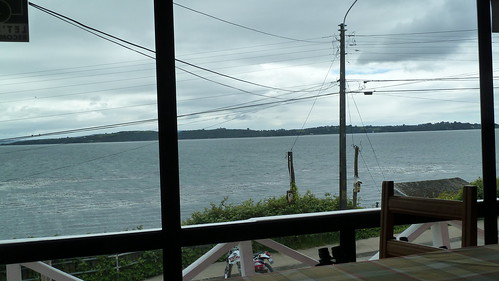
I'm staying at Hostal Lluhay, which is a low-cost place for grown-ups: every day they come clean your room, make the bed, and leave you new towels (some days scratchier than others). Breakfast is fine, but the "kuchen," at least this week, has a top layer of Jell-O. (Kuchen is normally a German-originated fruit crumble dessert.) But here's the view from the common/dining room:

P1010410

It's also a couple blocks from the town center, and the dining room has a very nice fireplace that eventually gives off heat.

Curanto is pitched as the culinary awesomeness of Chiloé. I've had curanto and its slightly smaller sibling pulmay (back at Sacho in Castro), and while I don't want to be jaded and negative, it's basically a clambake, but not as good. The shellfish, especially the clams, are full of sand, which I guess means they don't clean them (by leaving them alive in clean, sand-free water for a while). The sausage, chicken, and pork end up steamed, which gives them a weird texture and flavor. The broth was mediocre-to-tasty. Feel free to try it as a cultural experiment; I think it's vastly over-hyped, but I'm a food snob with a lot of seafood experience.

Food:
  • Retro's Pub - Probably the winner, given I'm avoiding Chilean food. Excellent service, good-enough nachos (made with Doritos, so don't expect them to satisfy a purist)`, excellent burgers (if slightly awkward at 6-7 inches wide).
  • Kuranton - Where I had the curanto. Meh.
  • La Botica de Café - Chilean-style sad espresso and no wifi, but it's smoke-free and pleasant, with excellent desserts. Ordering a ristretto gets you good espresso.
  • El Embrujo de Chiloé - I asked them to run the espresso machine for 30 seconds and they still failed. Ordering a ristretto was much better. Wireless, and nice people.
  • DH Pub - Hiding up Pudeto a few blocks from the center. They have Chilote beer, which isn't good (at least the lager/blonde), but they made a mighty whiskey sour and it came with some kind of fried-dough snackies with spicy cheese.

Stuff To Do:
  • Pingüinera Puñihuil - Penguins! Humboldt and Magellanic. Pictures here. It's a 3-4-hour jaunt unless you take the Mar Brava bus from their garage on Calle Anibal Pinto, which will leave you waiting on the beach for a couple hours. (I hitched a ride back with a private group.) If you've got an extra US$15 it might be worth a tour group, which will include other stuff; otherwise, take the bus or a taxi to the beach yourself and arrange with one of the two of three companies that actually take you out on the boat. Penguin verdict: cute and worthwhile, in beautiful secluded scenery.
It's a nice little town. I'm skipping the trip to Quemchi, which I'm fine with, since I was only going to a Chilote restaurant there. Ancud is an adorable little town, and for Chiloé in general, I could easily spend another week or more traveling around to different towns and islands.

Friday, December 3, 2010

beginning re-entry

I had a dream last night about completos, those nasty heavily-dressed hot dogs they serve here. In my dream, they sold them at an American school, like they sell them in schools here, but it was Americanized and looked like it was chicken curry in a hot dog bun. And a student slipped one in her pocket.

I'm starting to line up phone screens, and I'm nervous because:
  1. My head's not exactly in the space of solving computer problems, and
  2. I speak very slow and simple English, as if I'm speaking to second-language learners.
I catch myself thinking in Spanish, and I'm really good at catching myself, but once I'm yammering about software problems, who knows.

Also, even though I hate the food here and will be happy to be rid of various other things, I'm used to them.

This is gonna sting a bit.

contrarian

Answers you might not expect.
  • Chilean food is overwhelmingly boring. I know, we think of Latin America and we think "Spicy!", for both the people and the food. Most of our experience of Latin food is Mexican food, or maybe Central American. You'll be even more confused if you've had Peruvian food, which is flavorful. And it's true, Peru is right there on the northern border (albeit a couple thousand miles from where I am in Chile right now). However, Peru and Chile hate each other. And in Chile, the word for "spicy," picante, also means "low-class" and "tacky." Anthropologist Jim Stuart explains why.
  • The best thing about Chile was an empanada shop. Everyone expects something deep about this question. But my mind doesn't really work on linear-scale absolutes. Empanadas Las Tablas (Calle Ecuador in Vina del Mar) really is that good, and I talked a lot with the owner, Juan Pablo, who used to be a cop and went on a government-funded junket all up and down the American East Coast. The empanadas are so good that I pretty much got at least one every time I was in town, which was at least 3 times a week for aikido.
  • I don't like Dr. Bronner's liquid soap. My friends all love it, but I've traveled with it quite a bit now, and I hate it. It's difficult to lather up, and it leaves my hair brittle and my skin dry, and I don't really feel clean. Fine for washing clothes, but ugh.

Thursday, December 2, 2010

Ancud, Chiloé

Pictures are uploading: the internet here doesn't reach into my room, and I've been busy out and about. There's also a lack of internet-capable places in town, which is charmingly small-town. Especially funny since there appears to be municipal wi-fi, which I think confuses my computer because of how many networks there are.

Yesterday I had lunch with Corrie and her parents in Castro, then meandered over to Ancud. I'd thought about a trip back to Castro, but it's kind of a crappy road, so...no. Onward!

Ancud is a cute little town. I saw penguins today! Cute ones, hanging out on rocks, doing penguin things, off a secluded beach.

I spent a chunk of today chewing on an email from an old friend, who is sort of an old acquaintance at this point, since they don't respond to any of my attempts to keep in touch. That touches some unpleasant patterns in our history together, so I've been sorting out what I need in order for a friendship to feel alive and vital, and how reasonable I'm being in finally reaching a breaking point. It's a lot more fun to daydream about going home, but since it's here, I have to engage with it and feel my way forward.

Tomorrow will be 11 days until I'm back home with the girl and the kid. Hard to believe I'm traveling another week. I think I've been working too hard, and tomorrow maybe I won't do much of anything.