Showing posts with label fiddling. Show all posts

Wednesday, November 23, 2022

that could have gone better.

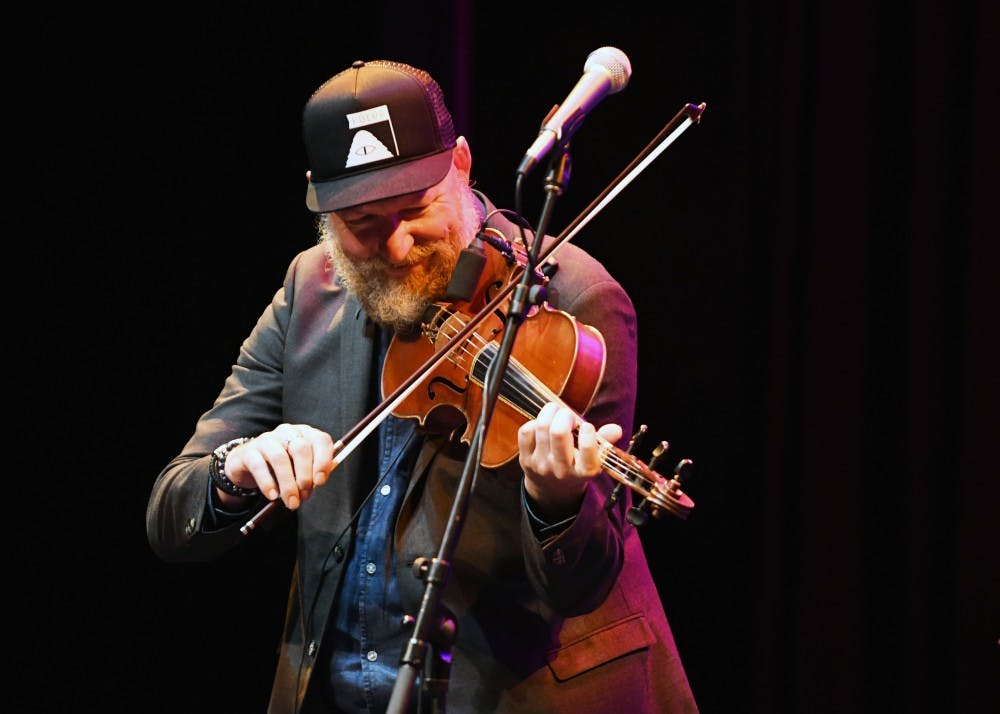
There's a phenomenal fiddle+guitar duo out of Boston, called Rakish, and when I saw they have a new album out, I thought I'd see where they're touring. They don't usually come to the West Coast, obviously, but lo and behold, they were at the Bellingham (WA) Celtic Festival, doing a show, and leading a "session," which is an Irish/Scottish thing where musicians gather, usually in a pub, and a leader starts playing a tune, everyone else joins in, they play it for a few minutes, then signals the transition to the next song.

"How can this possibly work?", you ask. For some reason nobody wants to say this out loud, but the way it works, I shit you not, is that the participants know hundreds and thousands of tunes. Musicians do the same for the American offshoots of Irish/Scottish, what are now things like Old-Time and bluegrass. I saw it happen when I was at Fiddle Tunes in 2019. It's really daunting, if you don't know the tunes or you're not able to make it up as you go along. Or, like me, it takes you the entire eight repetitions of the tune just to start remembering the melody.

Rakish were absolutely stunning in concert, everything I could have hoped. And everything else about the week was the worst travel I've had since being in Mexico with The Bad Relationship™ twenty years ago.

It's a long story, but mostly, the Airbnb I rented turned out to have had cats living in it for several weeks. It was a huge place, beautiful woodwork all over, with a million little places cats would just love: for example, the roll-out shelves where I put my clothes. I found out the cat thing after the first night.

(There is a pattern in my family tree of fathers who don't want cats in the house justifying it to the kids by falsely claiming to be allergic to cats. I however, am actually allergic to cats. Not anaphylactic-shock allergic, but it's easy to overwhelm anything an antihistamine can do for me.)

The hosts were super nice about it, and they worked with Airbnb to refund my remaining nights. It's definitely their fault—cats were mentioned briefly in the last line of the listing, and the house is so big it couldn't be de-catted in just the few hours used for cleaning. I moved myself to a hotel.

Unpacking my clothes at the hotel, my ears started to itch again, and I realized I was going to have to wash all my clothes. Bellingham turns out to have the best laundromat I've ever seen, but even so, it sucked up most of a day.

The hotel couldn't extend my stay to my last day, and it was just an ordinary hotel, so rather than fuck around with it, I reserved a different Airbnb for the last few days. I carefully asked the host about cats first. Success!

I went to a workshop about playing in sessions, which I was really hopeful about, because I want to play music with other humans. But it turned out to be a very very very chatty Irish-American, who just went on and on, talking about balancing the various interpersonal and musical dynamics of a group. That is (a) how I make a living, and (b) something I've been doing for 30 years, in theater and music before I was in tech.

On the bright side, there's a lawyer from L.A. who I'd originally talked to when I first wanted to buy a Mats Nordwall cittern, eons ago, and he's generally been down an expert version of my musical path, so it was surprising to discover he was staying on the floor above me. For his part, he and his girlfriend had no idea there was another unit in the basement there, so they had a different surprise.

And finally, one of my least restful vacations ever came to an end, and I got to go home, exhausted and dissatisfied. That didn't last long, since I got laid off a couple weeks after, and had a whole series of other things to think about.

Monday, August 5, 2019

lots of surprises.

I'm not sure how many people pick up the violin because of Swedish folk music. Outside of Sweden, and possibly Minnesota, probably not many. I'm actually not sure there's many inside of Sweden, either: tons of people (possibly most) spending their time performing folk fiddling traditions have music degrees and/or started playing as children, and after mastering the classical tradition, either returned again to the music of their childhoods, or learned it for the first time and found it more satisfying.

Don't get me wrong: I like Irish and Scottish fiddling, and Cape Breton, and bluegrass, and old-time. And Quèbecois, although I think you have to be able to dance while playing, so it will probably remain beyond me: the percussion in this track is the fiddler chair-clogging.


I don't really care for Cajun or zydeco fiddling, except in moderation, but I won't claim there's any logic to that, because it all sounds repetitive and similar to me, which is equally well said of most fiddle music I do like, to say nothing of lots of other music I enjoy.

Of course, all those fiddle traditions (and more!) are one family, carried from France and Ireland and Scotland over to Canada and Appalachia and Louisiana, mixing with everything they encountered, like Spaniards, enslaved Africans, and each other. Like any instrument unconstrained by the tyrannies of fixed pitch, the violin is tailor-made for musical syncretism. Want to play music with quarter-tones? If you can hear the difference, and remember where you put your fingers, the violin will play it for you.

Owing to Scandinavia's failure to thoroughly colonize the Americas, Scandinavian fiddle music is...something else. And then within Scandinavia, as far as I can tell, Swedish music is weird. The thing that grabbed me about Swedish music is the same thing that makes it hard: everything about it is just unexpected. I have all these decades of listening to classical and Irish music (and Cajun, until admitting I didn't like it), but I listen to Swedish music, and I constantly feel like I had NO IDEA that note was coming. To say nothing of the rhythms: a Swedish polka is the Polish polka we're used to, in 2/4 time, but the Swedes have a polska, which sounds like this:


Notwithstanding that the band is a supergroup of Swedish Folk Revival ninjas, this is a Christmas concert for normal people, and this is the kind of music the audience is expecting. The musician Lena Jonsson (not in that concert) described the polska as "in 3/4, but the second beat comes sooner," which is enough to make most of us ordinary (and non-jazz) musicians cry out to the heavens. "WHAT THE HELL DOES THAT EVEN MEAN, THAT IS NOT WHAT A BEAT IS."

It's more of a pulse, and it's part of why the email from the local Nordic music ensemble told me to use the sheet music as a starting point, but not to invest too much time in it, since the band plays whatever it plays and mostly uses the music to remember how songs start.

I highly recommend watching the whole concert. It's so different, but so damn catchy.

Thursday, July 18, 2019

signature.


So here's a thing from Fiddle Tunes.

There's a famous (as these things go) Swedish folk band called Väsen (pronounced, for those of you getting any funny ideas from German, "Vessen," with an "e" roughly like that in "mess"). The fiddler, Mikael Marin, plays I always assumed was a large 5-string violin, which it sort of is, except he's a violist and it's a 5-string viola. This is a little confusing in that a 5-string viola has the viola strings (C-G-D-A) with the high E from a violin; a 5-string violin has the violin strings (G-D-A-E) with the low C from a viola. You wouldn't be playing world-class viola or violin repertoire on either one: even if there weren't compromises in the sound (relative to the classical norms), you'd be hard-pressed to get the classical music world to take you seriously. They're mostly applied to folk traditions, like bluegrass. Or Swedish folk music.

Marin's instrument is visually striking just from a distance, because the fingerboard and tailpiece have a light-colored border:

Image result for mikael marin viola

It's hard to overstate how rare this is, except to say that to an untrained eye (including mine) every violin or viola looks exactly like every other violin or viola, going back centuries. And it's not like people haven't experimented, but they repeatedly come back to the classics: witness this shop selling no less than four copies (probably more) of Guarneri del Gesù's Il Cannone violin. Which was made in 1743! The modern guitar is a kaleidoscope of designs, and didn't even exist until the 1800s.

The fingerboard in particular has remained a sacrosanct black for a long time now, typically ebony, glued onto a neck made of maple. Some original baroque violins had inlays on the fingerboard, and of course Norway's Hardanger fiddle is off getting high on its own supply. The online consensus about fingerboard inlay seems to be that

  • Over enough time and environment changes, the surface can become uneven as the inlay shrinks or expands at a different rate than the fingerboard.
  • It makes a weird violin and you'll probably have trouble selling it.

Marin's viola was made by a famous Swedish luthier, Per Klinga (who died last year), and is clearly of the "I am going to play this until I die and I don't care who has to deal with it after that" class. I just assumed Marin had asked for it as a feature (and his wife Mia has a matching 5-string violin).

Except...Anna Lindblad, who was teaching at Fiddle Tunes with her bandmates, has one too! It seems pretty common on Klinga's instruments.


I got to see it up close when I went to ask her about it after class, and it's beautiful. I couldn't see everything the maker did, but the light-colored outline around the fingerboard is this stunning curly maple, all striped and finished to play with the light hitting it.

As it happens, Per Klinga's instruments are famous in and around Sweden and its music, and if anyone wanted to sell one, it would probably take all of a week before someone took them up on it. The old advice goes to buy an instrument that makes you want to pick it up and play; I couldn't pick it up, but I really, really wanted to play it.

Wednesday, July 10, 2019

back home on the farm.

The trip home was no less stressful than the trip out: while no instruments fell on my head--I claimed a window seat on the shuttle, out of range of falling luggage--when I went to print my boarding pass on Saturday, I discovered I had somehow booked my return flight for the same day I left, meaning I was supposed to leave on Sunday but had no flight booked. Getting home before Monday was expensive.

A variety of household stuff went dramatically poorly while I was gone, and kept going for a couple days after I got home, so in retrospect certainly the trip wasn't worth it, as amazing as it was.

I did the math later in the week, and including my lessons, I crammed about two months of playing time into a week. Physically this was not at all as hard as I expected: my decision to back off the guitar and mandolin, which use exactly the motions of the left thumb I need to learn not to use on the violin, is clearly the right one.

Every morning there were two classes with the "artist faculty," well-known (relatively) performers who span a bunch of different traditions: Scandinavian, Irish, old-time, Quebecois, Cajun, Cape Breton, and others more obscure or hybridized. After lunch there's "Band Lab," where you learn and prep a few songs to play at a dance on Friday night and a concert on Sunday. Finally the end of the day has sessions with tutorial staff, who are about the same level as the Artist Faculty, and cover the same range of styles, but not as famous.

I went to a class with Donna Hébert, who's sort of a general northeastern North America person, but then I remembered that Swedish music is why I picked up the instrument in the first place, so I mostly stayed with the Scandinavians the rest of the time. The morning teachers were Fru Skagerrak, a trio of Danish, Norwegian, and Swedish women, and they were amazing. At some point I realized I'd actually heard of Anna Lindblad (Sweden), but mostly through random YouTube videos.

Everybody was really nice! And also way above my head. Most of the time, every available space, inside and out, was full of groups that sounded like this:


That's not a specific band, just a circle of very good players. They all either know the songs, or they have the skills to pick it up as they go. Nobody called the tune, or the change. It was pretty daunting, and the only circle I was really able to join was a group of drunk twentysomethings on Friday or Saturday night, who were declining (and/or too drunk) to play at their full speed. It was fun! But I have a long way to go.

The attendees were mostly white, with a skew towards folks near or past retirement, who could take a week without working. The one non-white performer was Fiddlin' Earl White, who seems to have spent his decades moving around the country every 3-5 years collecting and transmitting fiddle repertoire. He performed in the finale concert on Saturday (open to the public, which most of the week's concerts weren't).

Now, there was a Kids Track and a Teens Track, and the teens were led by The Onlies, a group that themselves grew up going to Fiddle Tunes and the kids' and teens' programs (there's an adorable video of them kicking ass at a dance in 2011). The Onlies taught the kids a Swedish polska (not the same as a polka), and then a super-catchy fiddle tune blended with a secularized (and also catchy) tune called "I Belong To The Band, Hallelujah!".

The teens played at the public finale! They were great. Then Fiddlin' Earl White gets up and does a set with his band, then says, "That tune they played before is called 'Chips and Sauce,' by the clog dancer Ira Bernstein. And I actually taught it to The Onlies, several years ago. Here's the original."


Around and around it goes.

Fru Skagerrak played a set, too, including a bunch of Anna Lindblad's songs that I now want to learn, as it turns out she is a kick-ass songwriter. They played a convincingly Swedish tune, which was actually written by a Cajun musician, who had met the Swedish group Väsen many many years ago when they were at some music festival in Louisiana, and the Cajun guy then went home and wrote a Swedish song. Which was then performed by a Scandinavian trio, at a festival in Washington state.

Around and around it goes.

The final song of their set was this Anna Lindblad tune, from her album Med vänner ("With friends"). The dancer is Nic Gareiss (here's a great video of the two of them playing Quebecois songs), and the guitarist is the amazing Roger Tallroth from Väsen. Lindblad wrote the song about the friends and music you meet at festivals like the Tønder Festival in Denmark, where she met the other 2/3 of Fru Skagerrak. It's a Cajun/Zydeco tune, by a Swede.


Around and around it goes.

Tuesday, July 2, 2019

FIDDLE TUNES SUMMER CAMP

I'm spending the week away from the family, in the breezy and gentrifying Port Townsend, Washington, at the annual Fiddle Tunes Workshop (or whatever it's called--the name has changed over time). It's about 2.5 hours from Seattle-Tacoma International Airport, and it turns out to be a little out in the sticks. This is probably because Sea-Tac itself is sort of in the sticks, and then you have to cross a bunch of salt water to get here.

Fort Worden is one of a triangle of Army bases built to make naval attacks on Puget Sound a fruitless suicide mission. Then we invented airplanes, won World War II, and it eventually became a state park, with an arts organization to take up residence. I didn't grow up around military bases back East, so maybe they all look like this, but the architecture here is the same as the former bases I've seen in California: tall, blocky, gratuitously unattractive. Unlike the Presidio, these all need paint, but there's a lot of moisture in the air, and the money is better spent giving kids music lessons.

The trip out was a little rough in spots. I discovered that I hadn't gotten the helpful email about which shuttle I should be on, because the paperwork didn't go through and I wasn't on the list. There was space much sooner than I expected, which was great! It was a little airporter kind of shuttle, with the ceiling racks full of instruments. I put my seatbelt on, but said to my seatmate, "For all the good a seatbelt will do us, given all these instrument cases waiting to be flung into us."

You can guess who was the only person to have an instrument fall on their head. I didn't see it coming, so there was no chance to dodge, and very loud reflexive profanity. I'm grateful it was a lightweight foam case: a banjo, or the kind of fiberglass or carbon fiber cases you use for really nice violins, would have given me a nice concussion, instead of just ringing my bell a bit.

Day 1 went really well! I'm surprisingly better than I assumed I was. Day 2 was harder, as I'm still tired and I also went on an epic walk into town last night. But I'm on vacation! It's been a while. Maybe I've forgotten how to be on vacation.